
Queer Lives, Queer Texts: Literature, Identity, Desire, and Resistance
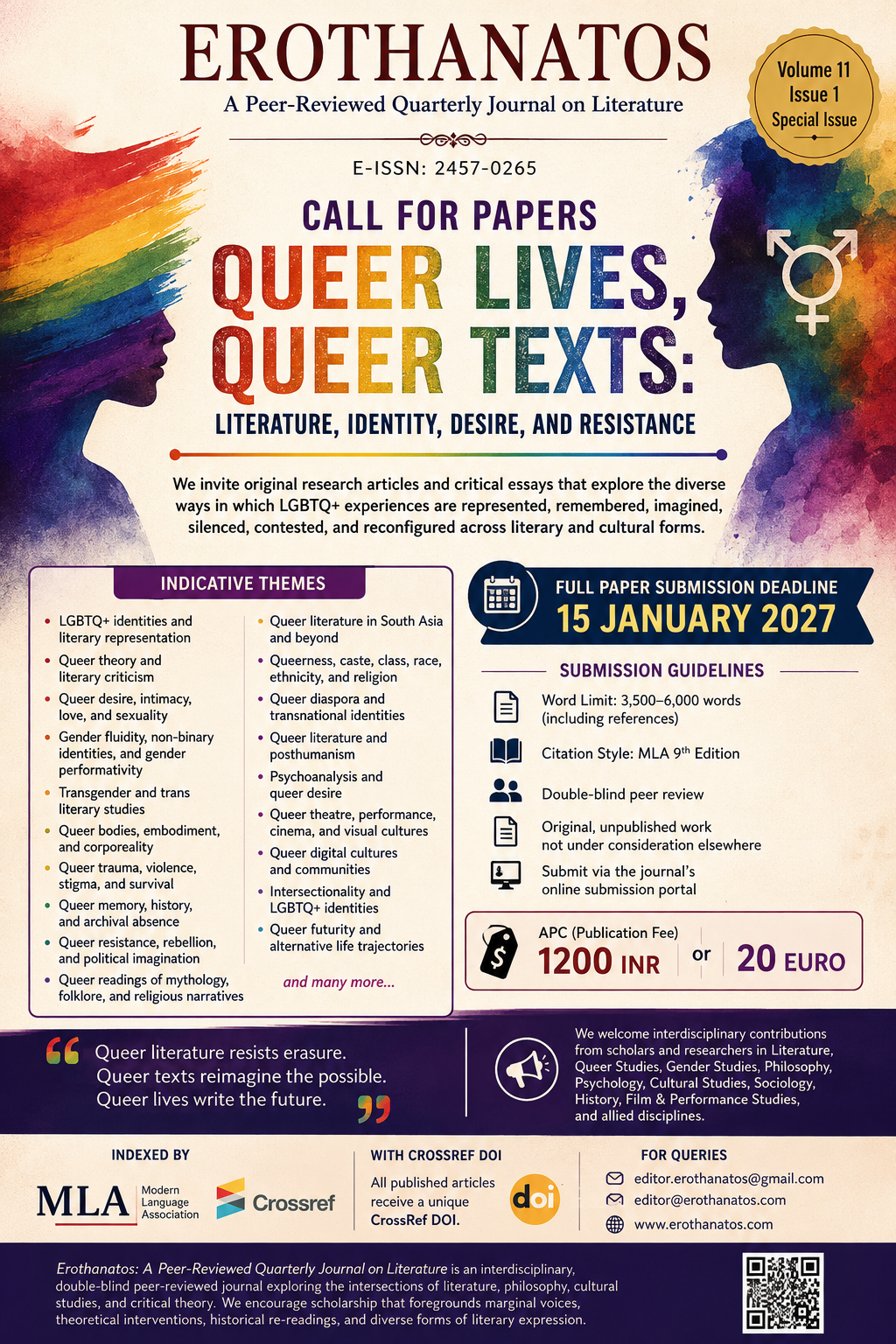
CALL FOR PAPERS
Queer Lives, Queer Texts: Literature, Identity, Desire, and Resistance
Erothanatos: A Peer-Reviewed Quarterly Journal on Literature
E-ISSN: 2457-0265
Volume 11, Issue 1 | Special Issue
Submission Deadline: 15 January 2027
Literature has long provided a space in which desires are articulated, identities are negotiated, bodies are contested, and normative structures are challenged. LGBTQ+ lives and experiences have increasingly become significant sites of literary and cultural inquiry, opening critical questions concerning sexuality, gender, embodiment, desire, identity, memory, belonging, marginality, resistance, and social transformation.
For Volume 11, Issue 1, Erothanatos invites original research articles and critical essays for a special issue titled “Queer Lives, Queer Texts: Literature, Identity, Desire, and Resistance.” The issue seeks to explore the diverse ways in which LGBTQ+ experiences are represented, remembered, imagined, silenced, contested, and reconfigured across literary and cultural forms.
The title Erothanatos itself invokes the enduring tension between Eros and Thanatos—desire and dissolution, life and death, intimacy and loss. Queer studies offers particularly productive possibilities for reconsidering these tensions: queer desire has historically been subjected to regulation, stigma, erasure, and violence, while queer literature has simultaneously created spaces of survival, self-fashioning, community, resistance, and alternative forms of futurity.
The special issue, therefore, welcomes interdisciplinary and theoretically informed approaches to LGBTQ+ literature and culture. Contributions may engage with queer theory, gender studies, feminist theory, psychoanalysis, poststructuralism, postcolonial studies, affect theory, trauma and memory studies, medical humanities, disability studies, cultural studies, and other relevant critical frameworks.
Particular attention will be given to contributions that move beyond representational approaches to examine how literature itself produces, destabilises, and reimagines categories of gender and sexuality.
Indicative Themes
The following themes are suggestive rather than exhaustive:
LGBTQ+ identities and literary representation
Queer theory and literary criticism
Queer desire, intimacy, love, and sexuality
Gender fluidity, non-binary identities, and gender performativity
Transgender and trans literary studies
Lesbian, gay, bisexual, queer, and intersex narratives
Queer bodies, embodiment, and corporeality
Queer subjectivity and identity formation
Heteronormativity and its literary subversions
Queer resistance, rebellion, and political imagination
Queer trauma, violence, stigma, and survival
Queer memory, history, and archival absence
Queer temporality, futurity, and alternative life trajectories
Queer mourning, death, and the politics of loss
AIDS, HIV, illness, and medical humanities
Psychoanalysis and queer desire
Lacanian, Freudian, and post-Freudian approaches to sexuality
Butler, Foucault, Sedgwick, and contemporary queer theory
Queer affect and emotional worlds
Queer literature and posthumanism
Queer ecology and more-than-human sexuality
Queer and postcolonial identities
Queerness, caste, class, race, ethnicity, and religion
LGBTQ+ experiences in South Asian literature and culture
Queer narratives in Indian regional literatures
Queer readings of mythology, folklore, and religious narratives
Queer reinterpretations of classical and canonical texts
LGBTQ+ literature in translation
Queer theatre and performance
Queer cinema, television, and visual cultures
Queerness in popular culture and digital media
LGBTQ+ young adult literature
Queer children's literature and the politics of representation
Queer speculative fiction, fantasy, and dystopia
Queer fan cultures and digital communities
Censorship, banned literature, and queer expression
Queer publishing and literary communities
Intersectionality and LGBTQ+ identities
Queer politics of space, home, migration, and belonging
Queer diaspora and transnational identities
Queer masculinity and femininity
Queer feminism and feminist literary studies
Intersex representation and narratives of bodily difference
Queer disability studies
LGBTQ+ literature, law, and human rights
Contemporary developments in queer literary studies
Submission Guidelines
Word Limit: 3,500–6,000 words, including references.
Citation Style: MLA 9th Edition.
Submissions must be original, unpublished, and not under consideration elsewhere.
Manuscripts should be submitted in MS Word (.doc/.docx) format.
The manuscript should not contain the author's name, institutional affiliation, or other identifying information in order to facilitate double-blind peer review.
All submissions will undergo double-blind peer review.
Contributions should demonstrate clear engagement with relevant primary texts and appropriate theoretical scholarship.
We welcome contributions from scholars and researchers working in Literature, Queer Studies, Gender Studies, Cultural Studies, Philosophy, Psychology, Psychoanalysis, Sociology, History, Film and Performance Studies, Postcolonial Studies, and allied Humanities disciplines.
Important Date
Full Paper Submission Deadline: 15 January 2027
Publication: Erothanatos, Volume 11, Issue 1
Submission
Manuscripts may be submitted through the journal's online submission portal.
We invite critical engagements with queer lives, queer texts, queer desires, and the possibilities of queer futures.