
Archives
-
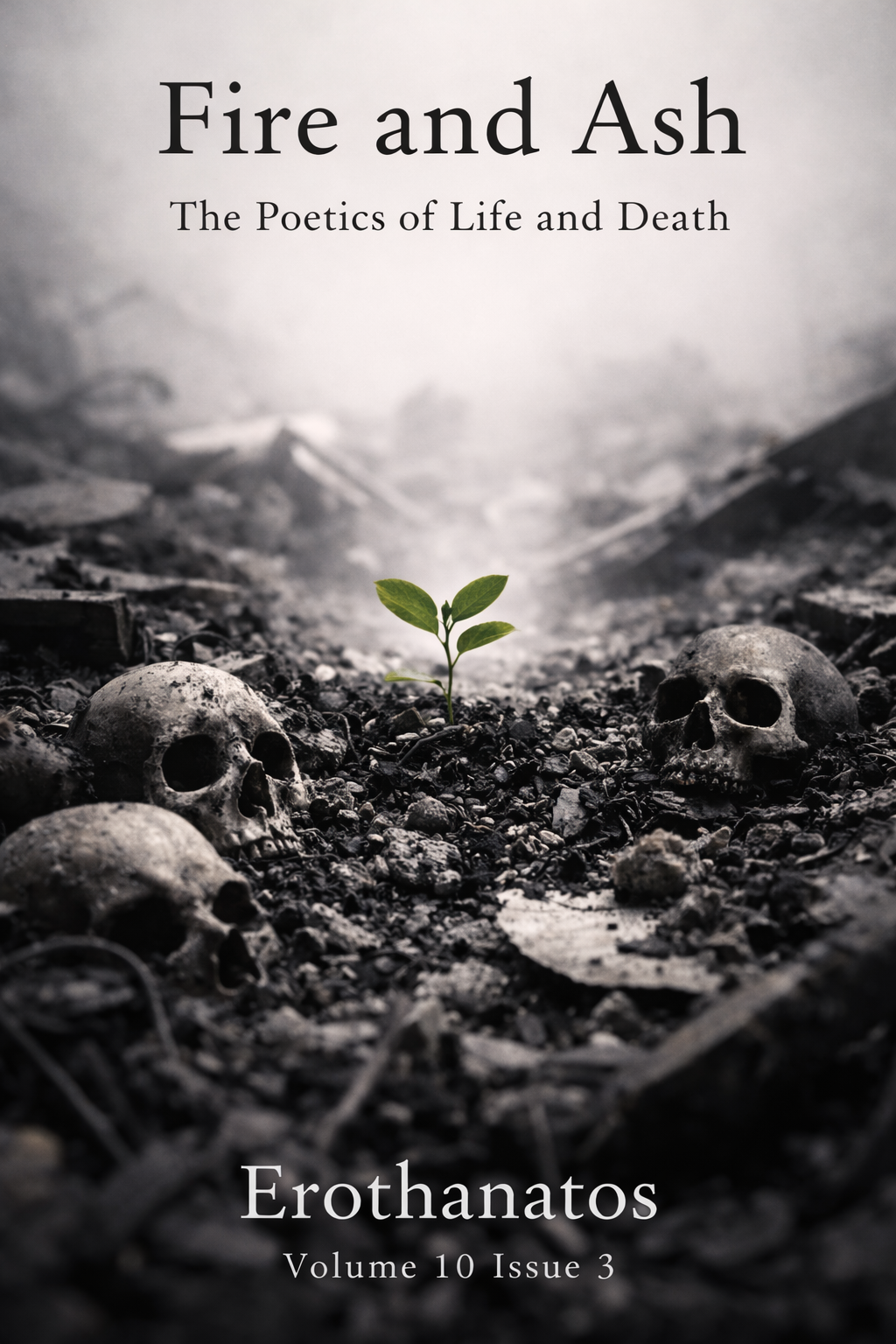
Fire and Ash: The Poetics of Life and Death
Vol. 10 No. 3 (2026)Fire and Ash: The Poetics of Life and Death
Theme Overview
From myth to modernity, from the tragic stage to the fragmented screen, the dialectic of Eros and Thanatos—Life and Death—has remained one of the most profound and recurring motifs in human imagination. To commemorate the 10th year of Erothanatos, the issue seeks to revisit and reinterpret this perennial tension between vitality and mortality, creation and dissolution, desire and negation.
The theme invites explorations into how writers, artists, and thinkers negotiate the paradox of existence: the drive to live, love, and create that is always shadowed by an awareness of decay and death. How does Eros sustain meaning in the face of Thanatos? Can the aesthetic or erotic impulse redeem the inevitability of death—or does it, paradoxically, stem from it?
-
Feast, Fast, Survive: The Poetics of Food and Life
Vol. 10 No. 2 (2026)Food is one of the most fundamental coordinates of human existence. It nurtures bodies, shapes cultures, anchors rituals, and sustains the rhythms of daily life. Yet its absence—whether enforced, self-chosen, or imposed—opens a complex field of meanings tied to suffering, resistance, sanctity, identity, and mortality. From the ascetic fasts of saints to the hunger strikes of political prisoners, from famine narratives to mythic depictions of divine hunger, from the symbolic politics of eating to the philosophical implications of starvation, the relationship between food and life, including the intervals of non-eating, reveals profound tensions between survival and transcendence, selfhood and society, eros and thanatos. This special issue seeks to explore how literary, cultural, philosophical, and artistic traditions conceptualize nourishment and deprivation, framing them as sites of meaning, conflict, and transformation.
-
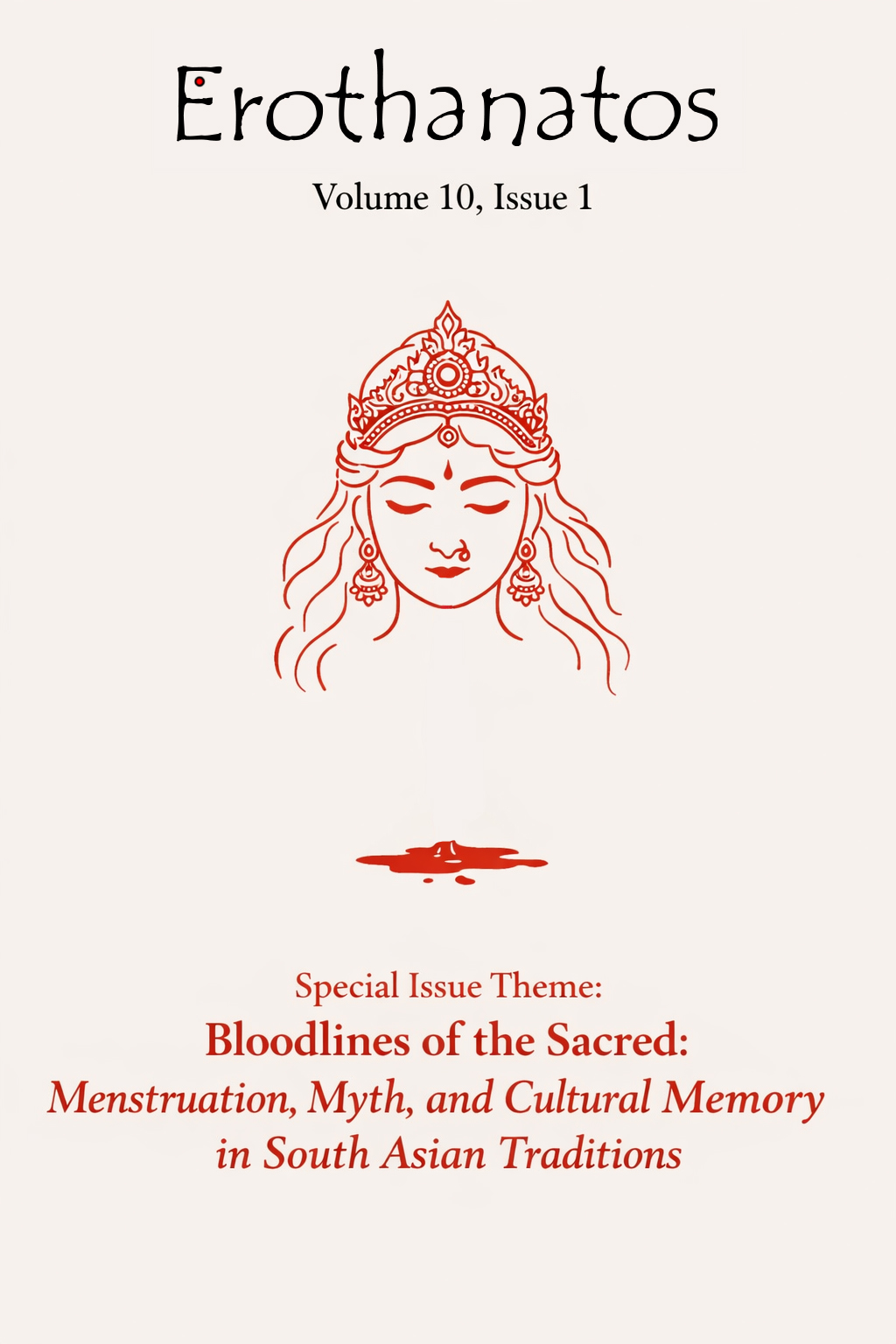
Bloodlines of the Sacred: Menstruation, Myth, and Cultural Memory in South Asian Traditions
Vol. 10 No. 1 (2026)Across the vast tapestry of South Asia, menstruation has long held a place not of shame, but of sacred significance. Rooted in ancient philosophies and earth-based wisdom, the menstrual cycle has been ritually observed, celebrated, and embedded into the cultural fabric of diverse communities—from the Goddess Kamakhya’s symbolic bleeding in Assam to the menstrual rest of Mother Earth during Raja Parba in Odisha. Raja, or Raja Parba, is a vibrant and unique three-day festival in Odisha where the earth herself is believed to menstruate. Agricultural activities are suspended, young girls swing in decorated yards, and festive foods are shared—all symbolising respect for nature's generative force and the restoration of feminine vitality. This ritual is a powerful reminder of how menstruation, when viewed through the lens of indigenous ecology, becomes a metaphor for renewal, fertility, and cosmic equilibrium.
Such cultural practices challenge dominant biomedical and patriarchal interpretations of menstruation. The Ambubachi Mela in Assam venerates the annual cycle of a goddess’s body; the Ritu Kala ceremonies in the South honour a girl’s transition into womanhood with gifts, ritual baths, and blessings. Tribal traditions across the central belt construct menstruation as both a spiritual threshold and a collective rite. This proposed scholarly volume seeks to reframe menstruation as a locus of cultural knowledge, spiritual agency, and ecological consciousness. Contributors are encouraged to explore cross-disciplinary approaches, ranging from ethnography and ritual studies to environmental humanities, folklore, disability studies, theology, and reproductive rights.
By re-engaging with rituals like Raja, the issue aims to revive and reinterpret the earth-based epistemologies that see menstruation not as pollution but as power, not as silence but as story.
Guest Editor: Dr Reshmi Deb Choudhury Das
About Dr Reshmi DC Das:
Dr Reshmi Deb Choudhury Das, a PhD Guide, Associate Professor, and Head, Department of English and Communication Skills, Mandsaur University. She comes with a rich, diverse experience spanning across Technical Institutions, Engineering Colleges and Universities, and has completed fourteen years of teaching experience. Dr Reshmi completed her PhD in English from Bharathiyar University, Coimbatore, and completed 150 hours of International teaching license from Westminster College, London.
Currently, she is actively involved in content development for ESL learners in and around the Malwa region, Madhya Pradesh
She has published 10 research articles in Scopus-indexed and peer-reviewed journals and two books with chapters ISBNs to her credit. Attended more than 30 FDPs, both national and international FDPs, and presented papers in various national & international conferences. Deliver a talk as a resource person on various platforms.
-
Erothanatos
Vol. 9 No. 4 (2025) -
Timeless Tales, Living Forms: Indian Myths in Art, Word, and Ritual
Vol. 9 No. 3 (2025)The enduring presence of Indian myths in the cultural and intellectual imagination reflects their remarkable adaptability across time and form. Indian myths are not relics of a distant past—they are living, breathing forms that pulse through the veins of our art, literature, and ritual practices. They whisper through folk songs, echo in temple sculptures, resurface in speculative fiction, and find new voices in feminist, Dalit, and queer narratives. This special issue of Erothanatos, titled “Timeless Tales, Living Forms: Indian Myths in Art, Word, and Ritual”, invites critical inquiries into the dynamic and ever-evolving manifestations of myth in India’s literary, artistic, and ritual traditions. Rooted in sacred texts and folk narratives, Indian myths continue to be revisited, reinterpreted, and reimagined through diverse mediums—from classical epics and tribal storytelling to digital art and feminist retellings.
As Guest Associate Editor, I envision this issue as a confluence of scholarly perspectives that engage with myth not merely as inherited narratives, but as living cultural texts—texts that resist closure, invite dialogue, and shape socio-political realities. Whether through the lens of resistance in Dalit literature, the reconfigurations of gender in mythic re-narrations, or the visual aesthetics of contemporary reinterpretations, the contributions to this issue will interrogate the role of myth in constructing and contesting meaning across contexts.
This issue encourages nuanced engagements with myth as a site of cultural memory, political symbolism, and artistic reinvention. It seeks to illuminate how ancient narratives are retold, resisted, and recontextualised in the shifting terrains of politics, gender, ecology, and performance. In gathering voices from diverse regions and disciplines, we hope to offer a kaleidoscopic view of Indian myth—its persistence, its transformations, and its power to both reflect and reshape the world we live in.
It is our hope that the discussions fostered herein will further enrich interdisciplinary discourse around Indian myths as both timeless tales and living forms.
Sneha Biswas, Guest Associate Editor
Assistant Professor of English, Amity University, Patna, India. -
Erothanatos
Vol. 9 No. 2 (2025) -
Erothanatos
Vol. 9 No. 1 (2025) -
Erothanatos
Vol. 8 No. 4 (2024) -
Erothanatos
Vol. 8 No. 3 (2024) -
Erothanatos
Vol. 8 No. 1 (2024) -
Erothanatos
Vol. 7 No. 4 (2023) -
Erothanatos
Vol. 7 No. 3 (2023) -
Erothanatos
Vol. 7 No. 2 (2023) -
Erothanatos
Vol. 6 No. 3 (2022) -
Erothanatos
Vol. 6 No. 2 (2022) -
Erothanatos
Vol. 6 No. 1 (2022) -
Erothanatos
Vol. 5 No. 2 (2021) -
Erothanatos
Vol. 5 No. 1 (2021) -
Erothanatos
Vol. 4 No. 3 (2020) -
Erothanatos
Vol. 4 No. 1 (2020) -
Erothanatos
Vol. 3 No. 4 (2019) -
Erothanatos
Vol. 3 No. 2 (2019) -
Erothanatos
Vol. 3 No. 1 (2019) -
Erothanatos
Vol. 2 No. 4 (2018) -
Erothanatos
Vol. 2 No. 3 (2018)