
Bleeding Goddess
The Kamakhaya Temple’s Folklore and Literary Reverberations in Assam
DOI:
https://doi.org/10.70042/eroth/1001249Keywords:
Menstruation, Kamakhya, Myth, RitualAbstract
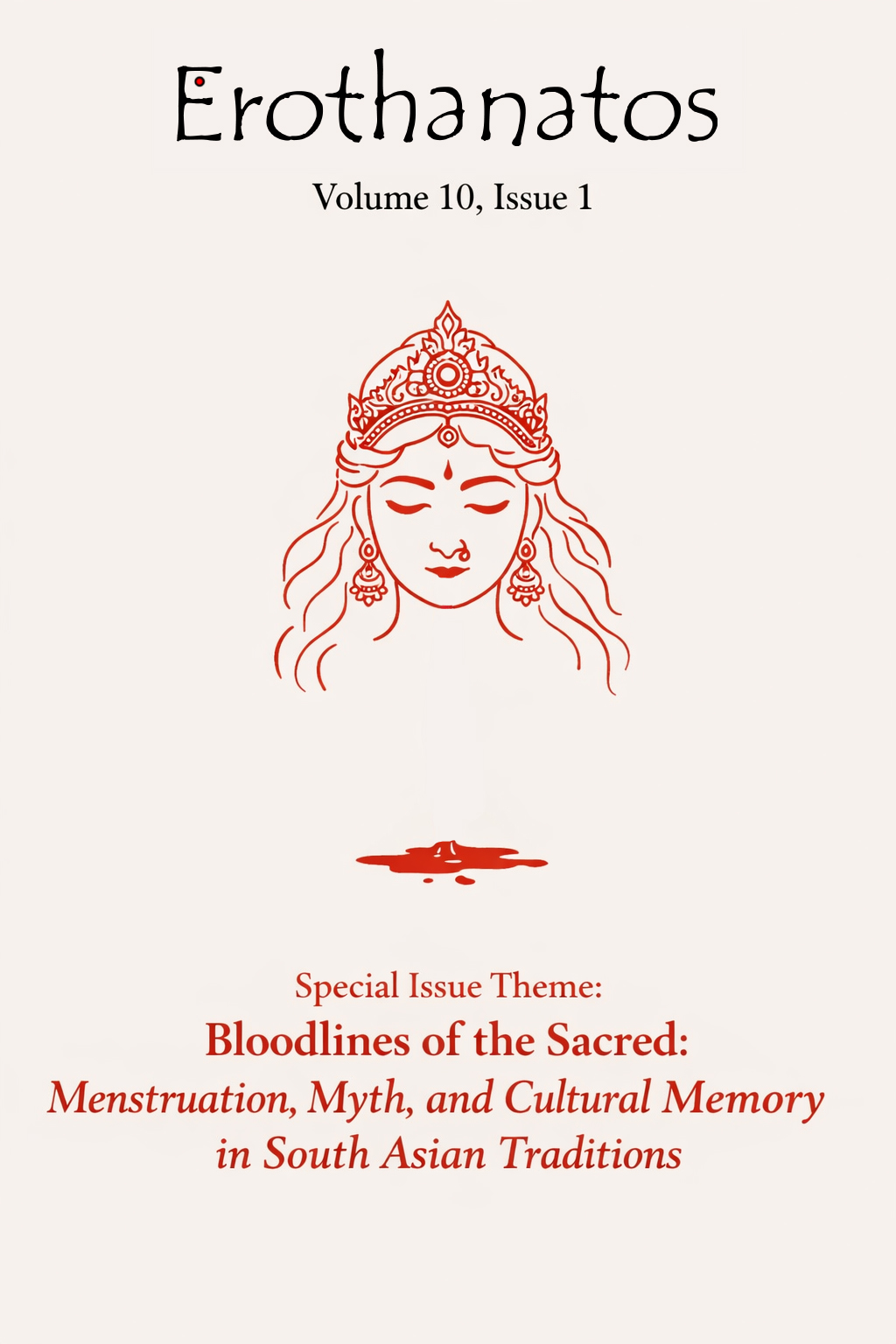
The Kamakhya Temple in Guwahati, Assam, uniquely sacralizes menstruation through the goddess's annual "bleeding" during Ambubachi Mela, transforming cultural taboos into symbols of fertility and renewal. This paper applies ecofeminist and ecocritical theories to analyze how this Tantric narrative reclaims feminine corporeality and ecological cycles against patriarchal and colonial erasures, drawing parallels in Assamese literary texts. The Kamakhya Temple venerates Goddess Kamakhya's yoni through her monsoon-aligned menstruation, celebrated in Ambubachi Mela, subverting menstrual stigma as cosmic Shakti. Rooted in Yogini Tantra and Kalika Purana myths of Sati's dismemberment, this folklore influences Assamese literature like Indira Goswami's works, framing blood as regenerative power. Employing Vandana Shiva's ecofeminism, which links women's marginalization to biodiversity loss—and ecocriticism's challenge to anthropocentrism, the paper argues Kamakhya resists dualisms of pure/impure, embodying earth-women unity. Ritual analysis reveals implications for gender justice amid climate disruptions, countering colonial demonization of Tantra.
Downloads
References
Bhabha, Homi K. The Location of Culture. Routledge, 1994.
Gait, Edward. A History of Assam. Thacker, Spink, 1926.
Goswami, Indira. The Man from Chinnamasta. Trans. Aruni Kashyap, Penguin, 2010.
Naess, Arne. "Deep Ecology." Ecology, Community and Lifestyle. Cambridge UP, 1989.
Spivak, Gayatri Chakravorty. "Can the Subaltern Speak?" Marxism and the Interpretation of
Culture, edited by Cary Nelson and Lawrence Grossberg, U of Illinois P, 1988, pp. 271-313.
Urban, Hugh B. "Kamakhya Research." kamakhya.org/published-research/, 2024.
These threads weave Kamakhya's praxis into decolonial, ecological, and queer liberation.
Buell, Lawrence. Writing for an Endangered World. Harvard UP, 2001.
Divakaruni, Chitra Banerjee. The Mistress of Spices. Anchor, 1997.
Goswami, Indira. The Man from Chinnamasta. Penguin, 2010.
Mohanty, Chandra Talpade. Feminism Without Borders. Duke UP, 2003.
Nixon, Rob. Slow Violence and the Environmentalism of the Poor. Harvard UP, 2011.
Shiva, Vandana. Staying Alive. Zed Books, 1988.
UNFPA. Menstrual Hygiene Management in India. 2024.
"Ambubachi Mela." Wikipedia, 23 Dec. 2009.
Web Sources (MLA 9th ed., accessed 1 Mar. 2026)
"Ambubachi Mela." Wikipedia, Wikimedia Foundation, 23 Dec. 2009,
en.wikipedia.org/wiki/Ambubachi_Mela.
"Examing Ecofeminism: Why Vandana Shiva Links Women and Earth." Scripted, 31 Dec.
2013, www.scripted.com/writing-samples/examing-ecofeminism-why-vandana-shiva-linkswomen-and-earth.[2]
"Foundation for History and Heritage Studies." Kamakhya.org, 18 Aug. 2024,
kamakhya.org/about-kamakhya-temples/history-heritage-foundation/.
Goswami, Indira. Man from Chinnamasta. Goodreads, 27 Jan.
2006, www.goodreads.com/book/show/12068699-man-from-chinnamasta.[4]
"Kamakhya Research - Academic & Cultural Studies." Kamakhya.org, 9 Dec. 2024,
kamakhya.org/published-research/.
"Kamakha." Screenworks, vol. 4, no. 1, 19 Jan.
2013, www.screenworks.org.uk/archive/volume-4-1/kamakha.[7]
"Ritualizing Menstruation Blood." Antrocom Journal of Anthropology,
kamakhya.org/published-research/, antrocom.net/wp/wp-content/uploads/2024/06/kakatiritualizing-menstruation-blood-kamakhya.pdf.
"Socio-Religious Significance of Kamakhya Temple in Guwahati, Assam." Medwin
Publishers, medwinpublishers.com/AEOAJ/socio-religious-significance-of-kamakhyatemple-in-guwahati-assam.pdf.
"Understanding the Pattern and Distribution of Sculptural Fragments at Kamakhya
Temple." ScienceDirect, www.sciencedirect.com/science/article/abs/pii/S2352226718300102
.[10]
Urban, Hugh B. "Kamakhya Research." Kamakhya Research, kamakhya.org/publishedresearch/. Accessed 28 Feb. 2026
Downloads
Published
Issue
Section
License
Copyright (c) 2026 Authors retain copyright and grant Erothanatos: A Peer-Reviewed Quarterly Journal on Literature the right of first publication. This work is licensed under a Creative Commons Attribution–NonCommercial (CC BY-NC 4.0) International License.

This work is licensed under a Creative Commons Attribution-NonCommercial 4.0 International License.
All articles and content published in Erothanatos are made available under the terms of the Creative Commons Attribution-NonCommercial 4.0 International License (CC BY-NC 4.0), unless otherwise stated. This license permits users to copy, distribute, display, and perform the work, and to make derivative works, for non-commercial purposes only, provided the original author(s) and source are properly credited.
Authors retain the copyright to their work. In cases where a special issue is priorly declared to be published in book form with an ISBN, the copyright and licensing terms for that publication will be specified separately and communicated to contributing authors in advance.
By submitting to Erothanatos, authors agree to the terms of this license and acknowledge that their work will be freely accessible to the public and may be used for academic, educational, and non-commercial purposes in accordance with the terms of the CC BY-NC 4.0 license.
For further details about the license, please visit the Creative Commons website.